
Most homebuyers in East Bengaluru start their search the same way.
They see a 2 BHK listed at ₹1.05 Cr or a 3 BHK at ₹1.35 Cr, calculate the EMI, and feel the number is within reach.
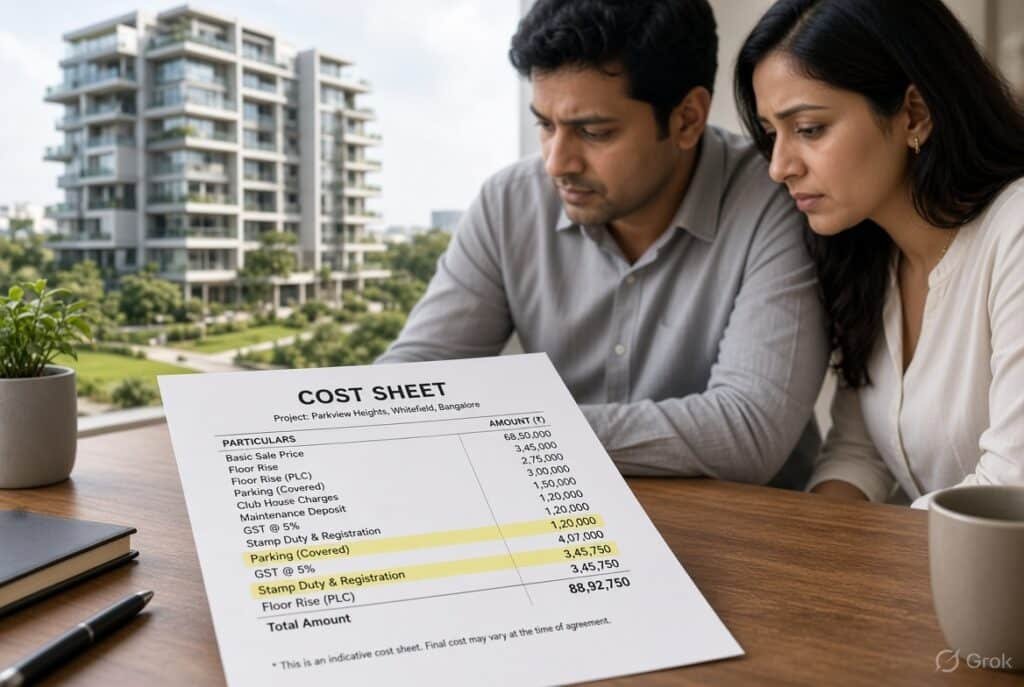
Then the cost sheet arrives.
Suddenly the same apartment is ₹20–35 lakh more expensive. Parking, preferential location charges, floor-rise premiums, GST, stamp duty, registration, maintenance deposits, and club membership all appear as separate line items. What looked affordable on the website becomes a stretch — or sometimes impossible — at the point of booking.
This is the Cost Sheet Trap, and it is one of the most common (and most expensive) surprises buyers face in Whitefield and Kannamangala in 2026.
Why the Advertised Price Is Almost Never the Final Price
The number you see on project websites, 99acres, Magicbricks, or developer brochures is usually the Base Sale Price (BSP). It covers only the apartment’s saleable area. Everything else is listed separately.
In the Whitefield–Kannamangala corridor, the extras typically add 20–30% on top of the base price. On a ₹1.20 Cr apartment, that can mean an additional ₹24–36 lakh before you even think about interiors.
Here is what usually appears on a real cost sheet:
| Cost Component | Typical Range (Whitefield / Kannamangala 2026) | Notes |
|---|---|---|
| Preferential Location Charge (PLC) | ₹150–600 per sq ft | Park-facing, corner, higher floor |
| Floor-rise charges | ₹50–300 per sq ft per floor | Higher floors cost more |
| Covered parking | ₹3–8 lakh per slot | Often mandatory |
| Club membership / infrastructure charges | ₹1.5–4 lakh | One-time |
| Maintenance deposit / corpus | ₹1–3 lakh | Usually 12–24 months advance |
| GST (under-construction only) | 5% of consideration | Zero if the project has Occupancy Certificate |
| Stamp duty | ~5% | Karnataka rates |
| Registration charges | ~1–2% | Increased in recent years |
| Legal & documentation | ₹25,000–60,000 | Buyer’s responsibility |
| Home loan processing & insurance | ₹40,000–1 lakh | Bank charges |
A Realistic Example
Let us take a mid-range 3 BHK of approximately 1,650 sq ft in the Kannamangala–Whitefield belt.
Advertised base price: ₹1.35 Cr
Typical additional costs:
- PLC + floor rise: ₹4–7 lakh
- Parking: ₹5 lakh
- Club + maintenance deposit: ₹3 lakh
- GST (if under-construction): ₹6.75 lakh
- Stamp duty + registration: ≈ ₹9–10 lakh
- Legal + loan charges: ≈ ₹80,000
Total all-in cost: roughly ₹1.60–1.70 Cr
That is a jump of ₹25–35 lakh. Many buyers only discover this after they have emotionally committed and paid a token amount.
The Biggest Variable: Ready-to-Move vs Under-Construction
This is where the difference becomes dramatic.
- Under-construction projects attract 5% GST (with no input tax credit for the buyer). On a ₹1.35 Cr apartment that is an extra ₹6.75 lakh that never comes back.
- Ready-to-move projects that already have an Occupancy Certificate (OC) do not attract GST.
In addition, ready-to-move buyers avoid the double financial burden of paying rent while also servicing pre-EMI during the construction period. Over two years that “waiting cost” can easily add another ₹8–15 lakh depending on your rent and loan size.
When you add GST + waiting costs, the apparent price advantage of many under-construction projects often disappears — or even reverses.
How to Protect Yourself Before You Book
- Ask for the complete cost sheet in writing before paying any token amount. Do not accept verbal estimates.
- Clarify Occupancy Certificate status. If the project does not yet have OC, GST will apply.
- Separate fixed costs from negotiable ones. Stamp duty and registration are fixed. PLC, parking, and club charges are sometimes negotiable, especially if inventory is moving slowly.
- Budget 25% above the base price as a working rule of thumb for Whitefield and Kannamangala in 2026.
- Include interiors and moving costs in your overall plan. Basic interiors for a 3 BHK commonly start at ₹12–18 lakh.
- Calculate the all-in EMI, not the base-price EMI. Banks finance only the agreement value; the extras come from your pocket.
A Clearer Way to Compare Projects
Instead of comparing “₹1.20 Cr vs ₹1.35 Cr”, compare:
- All-in cost including every charge
- Possession timeline and OC status
- Actual usable carpet area
- Density and open space of the project
- Long-term maintenance charges
When you do this, many large high-density townships that look cheaper on paper become less attractive. Boutique projects with lower unit counts, higher open space, and ready or near-ready status often deliver better value once the full cost is calculated.
Final Thought
The cost sheet is not a minor administrative document. It is the real price of the home.
Buyers who treat the advertised base price as the final number frequently face stress, delayed decisions, or compromised choices. Buyers who insist on the complete picture from the first conversation make calmer, more confident decisions — and usually end up with a home that fits both their lifestyle and their actual budget.
If you are currently evaluating 2, 3 or 4 BHK options in Kannamangala or Whitefield, request the full cost sheet early. It is the single most effective way to avoid the Cost Sheet Trap.